Dating apps are built to keep you dating.
Dating apps have a built-in business-model tension: a dating app succeeds when you stop needing it.
I think dating apps have accidentally discovered a fascinating business problem:
A dating app succeeds when you stop needing the dating app.
That is… not an especially convenient property for a subscription business.
And somewhere down that rabbit hole is why I started building Emberside.

My own relationship with dating apps has always been a little strange. I’m ENM-aligned, which means opening most dating apps feels a bit like arriving in another country with a phrasebook that contains exactly three sentences.
- “Yes, I have a partner.”
- “No, I am not cheating on them.”
- “No, this does not mean I am looking exclusively for casual sex.”
Most dating products are fundamentally built around one relationship shape: two single people meet, become a couple, and ideally wander off into the sunset.
Everything else tends to get bolted on afterward.
You can select “non-monogamous.” Maybe put “poly” in your bio. Perhaps add a tasteful little explanation of your entire relationship topology between your height and your favourite taco restaurant.
But “ENM” tells you almost nothing. ENM isn't "open relationships." It isn't "We spice things up once in a while." And it sure as heck isn't cheaters cheating with cheaters. It's a spectrum.
Someone might be solo polyamorous. They might have a nesting partner. They might want a closed triad. They might practice relationship anarchy. They might be married and looking for another serious relationship. They might be monogamish. They might want friendship, romance, sex, kink, companionship—or some wonderfully confusing combination of all five.
Those aren't profile decorations.
They determine whether two people can actually build something together.
So Emberside treats relationship shape as a first-class part of compatibility.
But while thinking about that problem, I ran headfirst into a much bigger one.
The economics of swiping are weird.
Most large dating platforms monetize some combination of subscriptions, likes, boosts, visibility, priority, and access to more opportunities to match.
There is nothing inherently sinister about that.
The problem is the incentive structure.
If your revenue depends partly on people continuing to search, then your product does not necessarily benefit from aggressively reducing the number of plausible candidates you see.
A very selective matchmaking system might look at 500 people and say:
“Good news! Four of these people are unusually compatible with you.”
A swipe marketplace has considerably more incentive to say:
“LOOK! PEOPLE! THERE ARE SO MANY PEOPLE! WOULD YOU LIKE TO SEE 500 MORE PEOPLE?!”
And then something predictable happens.
Men, facing low match and response rates, start casting wider nets. They swipe on everything.
Women receive an enormous volume of interest and have to sort through a swamp of mediocre or plainly incompatible matches.
- Messages disappear into the swamp.
- People get ghosted.
- The people being ghosted respond by casting even wider nets.
- The swamp becomes swampier.
Congratulations. We have invented a feedback loop. The swiping perpetuates to perpetuate the perpetuation of swiping.
And that's when we sell everyone a Boost.
That, to me, is much more interesting than the usual complaint that “dating apps suck.”
It is a market-design problem.
If you monetize the process of searching for a relationship, you have to be extraordinarily careful that your business does not become economically dependent on search being inefficient.
So I want Emberside's business model to work differently.
The basic machinery of meeting people—discovery, matching, conversation and community—should be useful without requiring somebody to continuously feed quarters into the machine.
Revenue can come from things around that experience: optional permanent upgrades, customization, advanced compatibility insights, convenience features, and other genuinely additive tools.
In other words:
I would rather sell you a better tool than sell you another spin of the roulette wheel.
That creates a useful constraint on product design.
If Emberside can confidently determine that two people are probably a terrible match, I want the product to be comfortable saying so.
If someone has 500 theoretically available people nearby but only 12 have compatible relationship structures, values, communication styles and intentions, showing them the other 488 doesn't make Emberside more useful.
It just makes the stack taller.
And compatibility itself goes much deeper than “you both like hiking.”
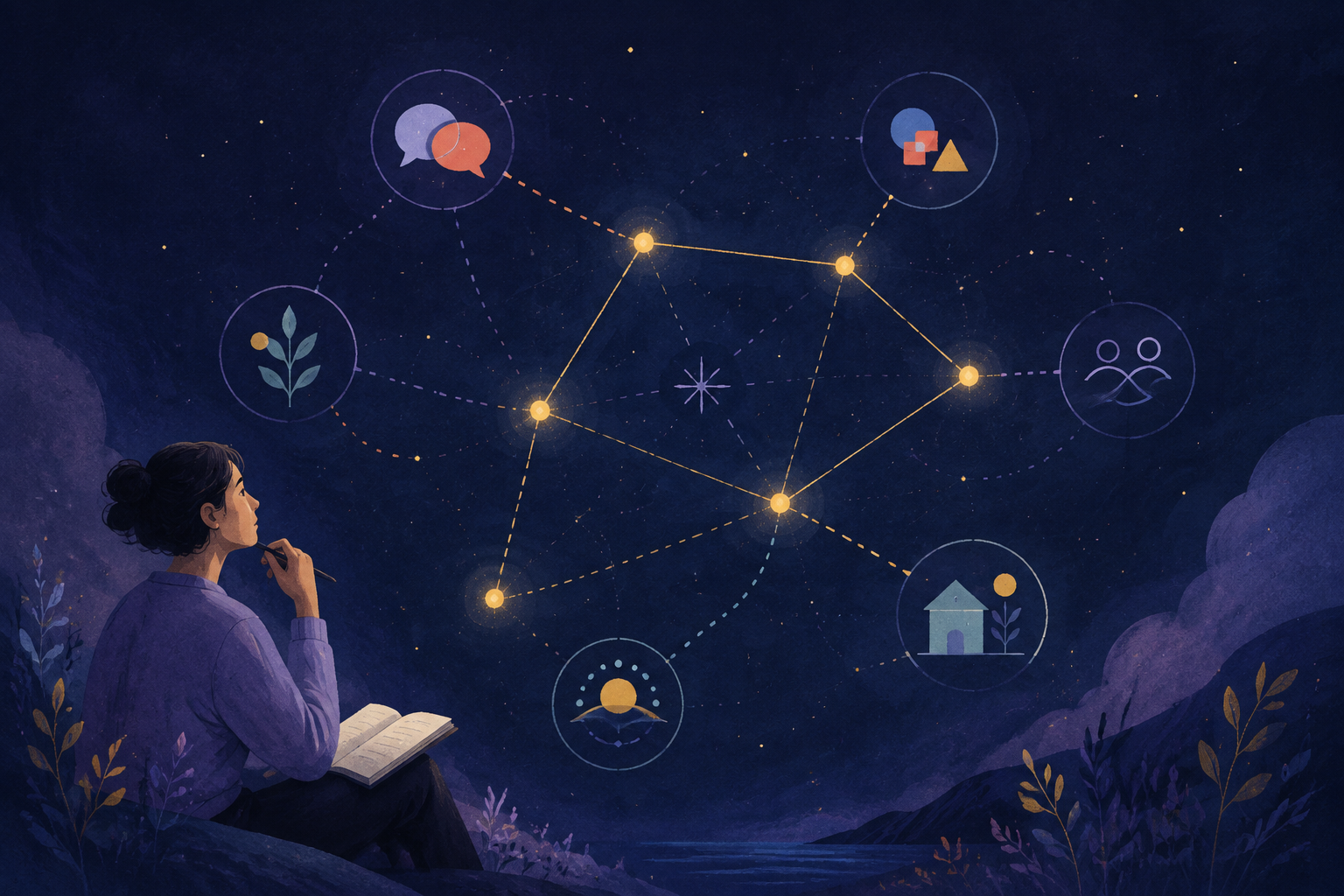
Emberside is being built around structured assessments covering things like relationship foundations, communication and connection, lifestyle, sexuality and kink, sensory needs, boundaries, values and other dimensions of how people actually function in relationships.
Not because an algorithm can tell you whom to love.
It absolutely cannot.
Humans remain inconveniently resistant to database normalization.
The goal is much more modest:
- Help people understand themselves.
- Help them find people with whom something promising might actually be possible.
- And help them understand why they may fit—or where friction is likely to appear—before six months of emotional archaeology is required to discover it manually.
That is the product I’ve been building.
It is also built in Canada by Canadians—and intended to welcome people everywhere.
It has turned into a wonderfully strange intersection of software engineering, psychology, marketplace design, product strategy, trust and safety, community design, and economics.
And while I’m continuing to look for my next full-time role, Emberside has also given me a place to keep building: designing the product, writing the software, architecting the platform, thinking through the economics, and repeatedly discovering that human relationships have more edge cases than distributed systems.
Which, as a distributed-systems person, is frankly impressive, if I do say so myself.
Want to hear more?
Check out Emberside's website.
Get notified about new features, calls for betatesters and articles just like this one through our early-access list.